Changing of the FinOps Guard: The Token has Landed
I went to the FinOps X conference in San Diego expecting AI to play a major role. My review of the vendors with booths told the story. Whether it be agents exploring optimization in conventional finops, adding token costs to dashboards, allocating AI spend to cost centers, or deep diving into contexts to attribute tokens to workloads, AI was, as expected, everywhere.
In a moment of foreshadowing, a Tokenomics Foundation was announced on June 3, one week before FinOps X opened. It gets better.
In the days on the floor, at the gatherings, and in the hallways, my gut was telling me something was different. The vendors were changing their playbooks, which we've discussed. It was the agenda that held the biggest tell. The classic sensor and wrench patterns of the finops practice were the same as years before. Back to before finops was a thing. The new curriculum was all focused on one thing. The right thing. AI.
As fate would have it, day three had one more announcement. Tokenomicon. A new conference that will replace FinOps X starting in 2027 and reduces conventional FinOps to a co-located track. The announcement mattered less as conference news than as confirmation that token economics has become the next operating model for technology spend. Still, many crying emojis were posted to LinkedIn that day.
Well. I was there for the first FinOps X and there for the last. Do I get a pin on my badge for that?
Status Quo
Accenture, Booking.com, Google Cloud, IBM, JPMorganChase, KPMG, Microsoft, Oracle, Salesforce, SAP, ServiceNow, and Flexera signed on as founding members. Officially, the Tokenomics Foundation operates as a sibling to the FinOps Foundation; neither governs the other. FinOps Foundation's Executive Director, J.R. Storment, was direct at the conference, stating that the most important thing is that the FinOps Foundation keeps doing everything it's been doing.
When a technology domain needs vendor-neutral governance, the Linux Foundation creates a sub-foundation, announces at a major event, seeds it with anchor members, and builds the standards body. Typically new bodies take a couple years to launch a conference; Tokenomics is only taking one. That says something.
Goldman Sachs projects global token usage will multiply 24 times between 2026 and 2030, reaching 120 quadrillion tokens per month, driven primarily by agentic AI adoption. Ramp reports average monthly enterprise AI token spend increased 13-fold since January 2025, a realized number rather than a projection.
The FinOps community's own adoption arc tells the same story from inside the discipline. Thirty-one percent of FinOps teams were actively managing AI spend in 2024. That reached 63 percent in 2025. In 2026, it is 98 percent. AI cost management is now the single most-requested new skill among FinOps practitioners.
Justified urgency.
Getting High
Much like early cloud days, per-token prices have dropped significantly since 2020. Roughly 98 percent, in fact. And yet, also matching the cloud patterns, enterprise AI bills are rising. These are not in tension, and that illustrates just how fast consumption is rising. Workload volume is multiplying faster than unit costs decline. Which amplifies that urgency.
Take a chat pilot that consumes millions of tokens monthly in trials but consumes billions at scale. Agentic AI compounds this. Literally. A single agent completing a complex task can burn 5 to 30 times the tokens of a simple interaction as context flows back and forth, into and out of tools, and across different remote LLMs.
The cost decline narrative has a second problem: it describes the commodity tier, not the frontier. The 2023 frontier was GPT-4 at $30/$60. The 2026 frontier is Claude Fable 5 at $10/$50. Or was, before the governments slapped it with export restrictions. Those aren't the same product repriced; they're different capability tiers. Budget conversations that treat "token prices are falling" as the whole story are comparing last year's frontier to this year's commodity tier, and the math doesn't work that way.
Another shift is at the application layer, and it's significant financial exposure. GitHub Copilot transitioned to usage-based billing on June 1. The seat fee stayed, but became a credit allocation, not a ceiling. Consumption above it bills at API rates. Power users running agentic sessions reported projected monthly costs jumping 10 to 50 times. I get it. Vendors are spending, on average, $1.69 per dollar they earn, and I've offered opinions on the ways providers will recoup losses, the key point being that AI costs are going up, regardless of what per-token costs are doing. Attribution is more important than it ever has been in the cloud.
Super-Size Me
Which brings up perhaps the most important thing: it's not just engineering that's using AI, though. Even companies without customer-facing AI are using the technology to accelerate and improve internal processes like marketing campaigns, hiring, document creation and review and pretty much anything you can imagine.
Cloud provider billing dashboards aggregate token spend at the usage-type level per day or per hour. For the attribution problem enterprises are actually trying to solve, which team, feature, or customer generated which cost, that resolution is insufficient.
At the moment, none of the three major providers surfaces per-request cost attribution natively. Each provides per-request token counts through opt-in logging, but converting those counts to dollar figures requires manual multiplication by per-model rates outside the billing system.
There are third-party tools that exist specifically to fill this gap. They intercept or trace every API call, compute per-request cost using known token rates, and attribute spend to a source (tracing) or the context itself. These tools can be used across an enterprise, but add latency to requests and will require scaling, logging, and aggregation for the attribution to succeed.
This might not be too exciting for companies that hold their cards close to their chests, which will likely see self-hosting win over SaaS. How this problem is solved is a debate right now, with competition in gateways, proxies, and middleware.
More Than a Token Effort
The Tokenomics Foundation, the Tokenomicon replacement of FinOps X, FOCUS spec work, the third-party observability tooling; all of it is pointed at the same outcome. AI spend needs to be a measurable, attributable cost category. For engineering workloads running through cloud APIs, it's getting there.
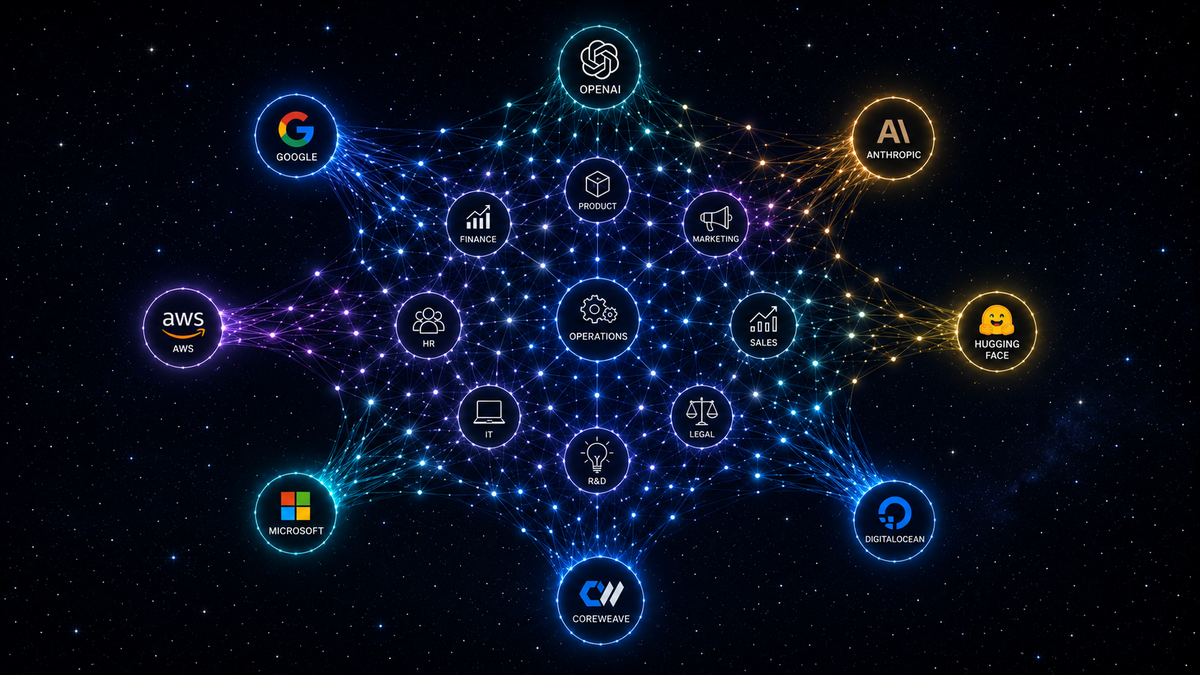
But AI is not an engineering cost, it's an enterprise cost. Marketing is consuming tokens through campaign platforms. HR is consuming them through recruiting tools. Sales is consuming them through CRM copilots. Legal is consuming them through contract review. Token costs are appearing in budgets and there's speculation it will be tied to bonuses and a negotiable item in job offers. Say what?
We all knew AI was here to stay, it's the industry being generated around it that may have taken many of us by surprise.