Airlines and AI Attention
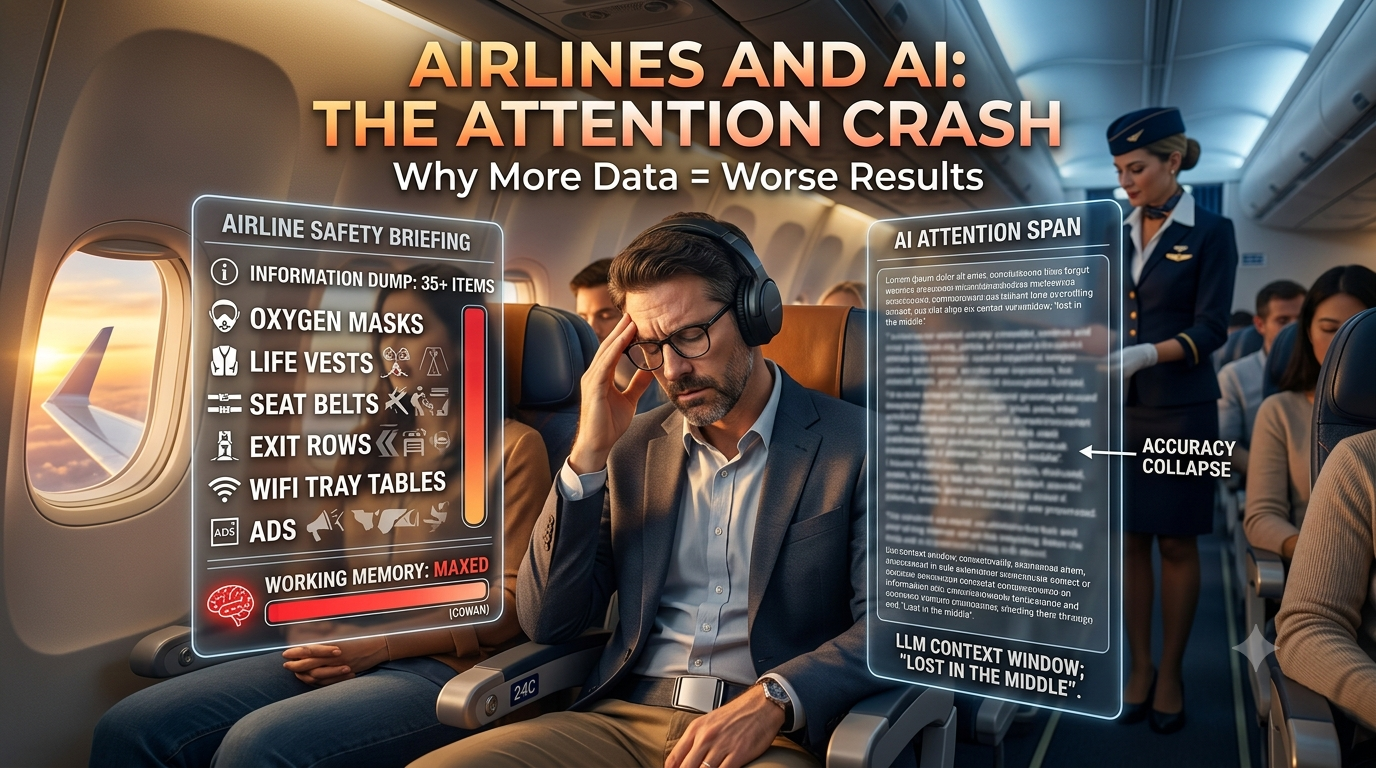
Have you ever noticed that the longer you stay engaged in a conversation with a chatbot (e.g. ChatGPT, Claude, Gemini), or the more attachments you add, the less useful (and possibly frustrating) the conversation can get? Maybe you see factual errors, or you have to prompt repeatedly to get a meaningful response.
The behavior of shoveling large amounts of data into AI and getting worse results than you would have with less information up front isn't unique; it happens with people, too. It's not that you shouldn't be well-informed when working on a project, it's the timeliness and portioning that matters. Take airliners, for example.
You're working your way onto a plane headed for Aruba. You've got seat 24C. In the next minutes, a voice will tell you about thirty-some-odd things. Maybe you will remember three. If you even hear them. A person's memory, in these types of floods, holds about four.
What You Are Being Told
A pre-flight safety briefing is a regulatory artifact assembled in layers. The base layer is federal: smoking prohibition, seatbelt operation, emergency exits. On top of it, the FAA recommends (and every major carrier includes) oxygen mask deployment, tray tables and seat position, floor-path lighting, exit-row responsibilities, "nearest exit may be behind you," and the safety information card.
International and overwater flights add the full life vest sequence: location, removal from pouch, donning, manual inflation, oral backup, vest light, and the critical instruction not to inflate inside the aircraft.
Then the operational layer: welcome aboard, destination, flight time, weather at arrival, Wi-Fi network and pricing, drink service, customs forms.
Stay with me.
Full domestic count: approximately three dozen discrete information units, delivered in three to five minutes. Overwater routes add even more.
Next you're flooded with advertisements about partnerships with hotels and branded travel cards. I've seen worse, but those two are pretty standard fare.
Apologies. That was a lot to take in. Does that illustrate the point?
What You Can Remember
George Miller established in 1956 that working memory holds approximately seven items, plus or minus two. Nelson Cowan revised that in 2001, narrowing the operative number for unstructured material to about four. A briefing of three dozen items is asking working memory to hold almost ten times its capacity.
Using that airline example, the open is usually a greeting and a thank you with maybe a "why we're so awesome" mixed in. Maybe you've already tuned out by the time they tell you not to put personal items in the overhead bins. Based on my experience, many people have.
Keeping your seatbelt fastened when seated seems intuitive enough considering most people do so in their cars. Then again, there are plenty of videos online of people getting thrown into the ceiling during turbulence. No smoking has been a thing for so long it's probably not relevant anymore (in fact, the smoking sign is often used as a signal from the cockpit to flight attendants now) but how many people will realize they mention vaping now, too?
By the time they get to lithium batteries, a massive concern in modern air travel, people might retain it, and then they flood you with the ads. Even those that pay attention are likely not to remember everything if quizzed.
For those seated in exit rows they get even more, but I've seen that gradually reduced to "are you willing and able to assist, I need a verbal yes". That verbal yes requires you to interact, and that resets things. One time I was actually asked "what's the first thing to do when opening the exit door" before answering the seemingly-static "yes". Keep that in mind.
What an LLM is Told and Can Remember
Large language models (LLMs) do not remember anything, they know only what they're fed in what's called a prompt. That prompt is any system instructions (those written by engineers and that you cannot see) prepended to what you typed, and any documents you attached are typically appended to that. It could be as simple as "how many r's in strawberry" (look it up if you don't know - it's hilarious) or as large as a multi-page document copied and pasted alongside many attachments.
LLMs have a context window: a fixed amount of information they can process at one time. Something we might wish our overly-chatty friends had, as well. The model can technically process more input, but it does not necessarily use all of that input equally well. Relevant information can become harder to recover when it is buried inside a long, noisy context. To solve that, chatbots generally repackage the conversation, the instructions, and the previous responses, effectively resending some of, if not all of, that context repeatedly with each new request.
As that window fills up, the model does not necessarily get smarter. The additional input shifts where the model focuses, and past a point, that shift stops working in your favor.
Is that different than talking with a friend? Probably not, those chats often begin with engaging new conversation, devolve into details you may or may not remember, and end with some sort of closure. You'll remember hello and goodbye, but the longer the conversation is the more likely you'll forget parts in between.
Attention Is Expensive
Whether it's you in seat 24C or an AI processing your request, the problem is the same: attention is a finite resource, and nobody budgets for it.
You board the plane already distracted. You're stowing a bag, checking your phone, maybe settling a kid. By the time the briefing starts, you're already spending attention on other things. The briefing does not get its own fresh pool. It gets whatever is left over. And every item added to that briefing does not expand what is left; it splits it thinner.
LLMs work the same way. The model has a fixed amount of processing it can dedicate to understanding the input. A short, focused prompt gets the full benefit. A long prompt stuffed with documents, prior conversation, and every edge case the developer could think of gets the same processing spread across ten times the material. Nothing crashes. Nothing throws an error. The output just quietly gets worse, and unless you know what to look for, you might not notice.
The people writing pre-flight briefings and the people engineering AI prompts share the same instinct: when something gets missed, add more. Passengers did not remember the lithium battery warning, so the FAA added more language. The model did not follow an instruction, so the developer added it again in bold with three examples. Both responses feel logical. Both make the problem worse. More information competing for the same limited attention means everything, including the thing you just added, gets less of it.
Nobody has solved it yet for AI prompts at scale, either. Right now, the burden is on agents, the software that connects to AI, not the LLM itself. Agents, like people, can make decisions about relevance and aim to be, as my former boss so eloquently said "concise and precise". It is better information, at the right time, in the right amount.
Think of the attendant asking me to answer a question before proceeding to ask for my "yes". The AI comparison is called human-in-the-loop; stopping partway before completion to get your input. It breaks up the information into more digestible pieces. Maybe an agent asks if you simply want an opinion on an email you're composing or a full rewrite.
Proof in the Pudding
In 2023, a research team from Stanford and Berkeley published a paper called "Lost in the Middle" that demonstrated something remarkably similar happening inside large language models. When the relevant information sat near the beginning or end of a long context, performance was strong. When it sat in the middle, accuracy collapsed. They tested this across context lengths and model architectures, and the pattern held. When the context was full and the relevant information was buried in the middle, the model missed it.
And yes, I know the proper expression is 'the proof of the pudding is in the eating'. So go eat. Talk to your friends and later, ideally when they're not still around, see how much you can remember and where that was positioned in the conversation. In your next chat with Claude or Gemini or whatever when you notice incorrect information or a failure to follow instructions, think about exactly where the missing information may have sat in the context, or just start a new thread where you left off.
Just don't expect the airlines to shorten their briefings any time soon.