What 57 FinOps X Sponsors Reveal About the Market in 2026
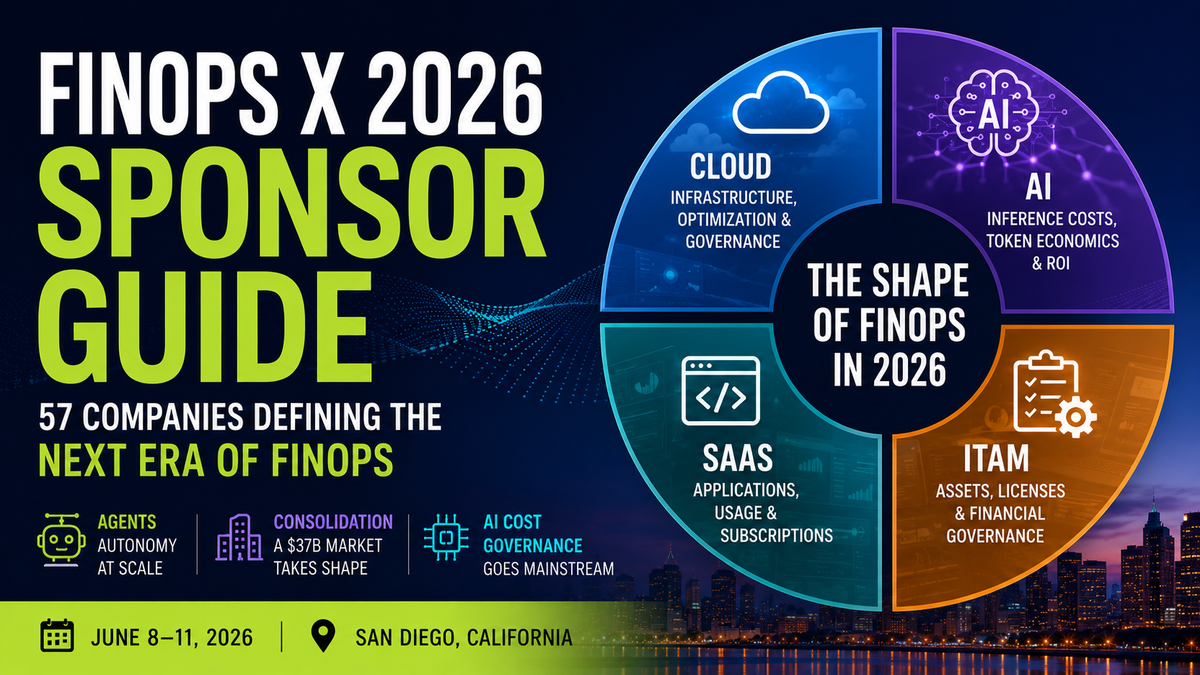
Fifty-seven companies paid for booth space at FinOps X 2026 in San Diego, June 8 through 11. This is a field guide to what those sponsorships reveal. Taken individually, each is a marketing decision. Taken together, they are a market map: three patterns dominate the 2026 cohort, and the sponsor-by-sponsor evidence either supports them, complicates them, or occasionally does both.
Of course, this is not a census of the FinOps industry. It is a snapshot of the companies willing to spend money to be in front of the FinOps community in June 2026. Some important vendors are missing. Some categories are overrepresented. Others barely appear at all. That bias is part of the signal. Sponsorship reflects where companies believe customers, budgets, and future growth opportunities exist, making the roster a useful indicator of where the market believes it is going.
How to use this guide
- Attendees: Use the alphabetical catalog as a booth-planning map. The tier and core specialty in each company header give you an orientation pass before you hit the floor.
- Non-attendees: Read the opening synthesis below for a snapshot of where FinOps is moving in 2026. The catalog is the supporting evidence.
- Both: The 57 sponsors cluster into roughly six categories. The table below maps the field before the entries begin.
- Note: Sponsorship tier (Diamond, Sapphire, Emerald, Ruby) reflects spend at this specific conference, not vendor capability or market position.
The 2026 Sponsor Landscape at a Glance
| Category | Example Sponsors | What It Signals |
|---|---|---|
| Hyperscalers | AWS, Microsoft Azure, Google Cloud, Oracle Cloud | All four hold Diamond tier; AI inference cost governance is now a core feature of every hyperscaler cost platform |
| Integrated Platforms (M&A roll-ups) | Flexera, doit, CloudBolt, CoreStack | Private equity is betting on platform consolidation; the mid-tier is compressing fast |
| Kubernetes/GPU Optimization | Cast.ai, ScaleOps, nOps, AMD | GPU utilization is the 2026 optimization frontier; Kubernetes is the operational layer where those costs are won or lost |
| AI and Token Economics | CloudZero, Harness, Finout, Pay-i, Kion | Who owns AI cost governance is unsettled; multiple sponsors are competing for this layer |
| Data and SaaS Cost | Espresso AI, Keebo, Unravel Data, Zylo | Cloud cost discipline is extending from infrastructure into data platforms and SaaS subscriptions |
| Services and SIs | Accenture, CDW, SHI, SoftwareOne, Virtasant | FinOps as a managed service embedded in enterprise transformation programs |
The Shape of the 2026 Market
Three patterns dominate the 2026 sponsor cohort. Vendors are shipping AI agent personas layered on top of cost dashboards. Private equity has rolled mid-tier players into platforms through a wave of acquisitions over the past 24 months. AI inference cost has become its own line item, with multiple sponsors now selling against the economics of large language model (LLM) tokens specifically.
The agentic pivot is real and nearly universal. Finout's Detector-Investigator-Orchestrator suite, nOps's Clara, Stacklet's Jun0, Kion's Lux, Sedai's self-driving cloud model, Wiv's Wivy, Unravel's Arvix, and ReveFi's Raden all reflect the same shift. By June 2026, a FinOps product without an AI agent interface is the exception. The underlying architectures vary widely: some agents are genuinely autonomous within guardrails, others are natural-language query interfaces using the agent label as positioning shorthand.
Two catalog entries sit outside the agentic frame but mark a related trajectory in how cost accountability moves through the software lifecycle. Infracost operates shift-left, inserting cost feedback at the pull-request stage and stopping bad infrastructure code before it deploys. Frugal operates post-deployment: its Application Cost Engineering (ACE) positioning maps live cloud and AI costs back to specific lines of application source code after the fact. Both are early-stage companies; both represent a direction the discipline is moving toward.
Private equity and growth capital are reshaping the FinOps vendor map. Flexera's four-acquisition roll-up between 2024 and January 2026 is the clearest expression, but doit's $250 million acquisition fund, SoftwareOne's Crayon merger, and CoreStack's BetterCloud acquisition follow the same underlying bet: private equity and growth investors believe the mid-tier of the FinOps market will compress into a handful of integrated platforms. The race to assemble those platforms is already underway. The Ruby tier at FinOps X 2026 contains the companies that have not yet been absorbed, either because they occupy defensible niches or because they are too early-stage to represent acquisition targets yet.
The AI cost subcategory is the newest and least settled of the three patterns. Multiple sponsors are competing for the canonical AI spend governance layer: CloudZero, Harness, Finout, Pay-i, Kion, Datadog, and hyperscaler-native tools all offer competing answers to the same question: when an organization spends $10 million a year on LLM inference, how does it know which business outcome received which dollar? The answer is not obvious, and the sponsor pool reflects genuine product differentiation in how different companies have chosen to approach it.
Of interest is the FOCUS specification. As the FinOps Foundation’s standard for normalized billing data continues to evolve, it sits at the center of a larger question: whether AI cost governance becomes a FinOps problem or develops as a parallel discipline. If future FOCUS releases incorporate token and GPU compute metrics into the core schema, FinOps absorbs more of the AI cost layer. If standardization lags, startups like Pay-i and Stitcher have room to build a separate ecosystem with their own community and standards.
June 2026 is too early to call either way. The 57 booths at the Marriott Marquis San Diego Marina represent the opening bids.
The Sponsor Catalog
Accenture (Diamond, Systems Integration)
Accenture traces its origins to the consulting division of Arthur Andersen, spinning off as Andersen Consulting in 1989 and rebranding in 2001. The Cloud First practice, launched in 2020 with a $3 billion internal commitment, is the organizing structure for Accenture's FinOps and cloud cost management services, delivered as part of broader managed cloud and digital transformation engagements for Fortune 500 enterprises rather than as a standalone product. At FinOps X 2026, Accenture anchors the systems-integrator category alongside CDW, SHI, and SoftwareOne, positioning FinOps capability as a managed service embedded in cloud transformation programs.
Adaptive6 (Emerald, Cloud Waste Detection)
Adaptive6 was founded by Unit 8200 alumni including CEO Aviv Revach, applying signal-detection methods from cybersecurity to the identification of undiscovered cloud cost anomalies. The company emerged from stealth in January 2026 with $44 million in total funding, including a $28 million Series A led by USVP, and introduced the "Cloud Cost Governance and Optimization" (CCGO) category as its market-positioning frame: a bid to define a distinct segment rather than compete within the existing FinOps platform taxonomy. Revach holds a seat on the FinOps Foundation Governing Board, giving the company early access to standards development. At FinOps X 2026, Adaptive6 is presenting a session co-presented with Ticketmaster as a named enterprise reference.
AMD (Sapphire, Datacenter GPU / Silicon Economics)
Advanced Micro Devices was founded in 1969 as a semiconductor manufacturer and entered serious datacenter GPU competition in the 2020s with its MI-series accelerators. The company acquired Pensando to extend infrastructure-processing capabilities and has positioned the MI300X and MI325X accelerators against Nvidia on cost-per-token economics for LLM training and inference workloads. Nvidia and Intel are the implicit competitive references at AMD's FinOps X presence: AMD does not sell a FinOps platform, but at a conference organized around AI spend, the choice of accelerator hardware is as much a FinOps decision as a performance one, and the chip-level economics argument lands squarely in that context.
Archera (Emerald, Commitment Insurance)
Archera was founded in 2019 in Bellevue, Washington as Reserved.ai by brothers Aran Khanna and Nikhil Khanna (Aran previously worked as an AI engineer at AWS; Nikhil served as a quantitative trader at D.E. Shaw) before rebranding. The company pioneered what it calls Insured Commitments: cloud reserved instances and savings plans underwritten by a third-party insurer, so customers can exit commitments without the usual financial penalty if usage patterns shift. This is a meaningfully different product from standard commitment optimization. Rather than modeling the optimal commitment purchase, Archera removes the primary reason customers under-commit by insuring the downside. The company has raised $27.5 million and secured $100 million in reinsurance capacity through Relm. A distribution alliance with Ingram Micro was announced in January 2026; a partnership with Sedai announced in May 2026 connects Archera's commitment insurance to Sedai's autonomous optimization decisions. At FinOps X 2026, Archera is likely to emphasize Insured Commitments as the answer to demand volatility driven by AI workload unpredictability.
Attrb (Ruby, eBPF / Tagless Attribution)
Attrb operates as Zouz Ops Ltd and was founded in January 2023 by Izhak Zimmermann and Liad Tropp, alumni of IDF Unit 81, a technology and engineering corps of Israeli military intelligence. The company's product uses eBPF (a kernel-level Linux technology that allows programs to run safely inside the operating system without modifying source code or adding application instrumentation) to attribute cloud costs to individual workloads without requiring tagging. This tagless approach is positioned against the tagging-and-allocation discipline that most FinOps platforms depend on, which breaks down in environments with dense microservices or inherited workloads with incomplete tag coverage. Attrb has raised funding from S Capital, IBI Tech Fund, and GUTS; total amount not publicly disclosed. The company received GKE Autopilot certification in July 2025, with Kubernetes kernel-level cost-per-pod attribution as the core demonstration at FinOps X 2026.
AWS (Diamond, Hyperscaler / FinOps Platform)
Amazon Web Services launched in 2006 and over two decades built the reference FinOps tool stack that the industry subsequently standardized around: Cost Explorer, Budgets, Savings Plans, and Cost and Usage Reports. The Cost Optimization Hub, launched in 2023, unified fragmented recommendations into a single surface. Recent developments include support for FOCUS 1.2 (the open, vendor-neutral schema standard for cloud billing data) across Cost and Usage Reports, Database Savings Plans extending commitment-based discounts to RDS and Aurora workloads, and Bedrock token-economics reporting that brings LLM inference spend into the standard cost surface alongside compute and storage. As the Diamond host hyperscaler at FinOps X 2026, AWS effectively sets the FOCUS adoption pace for the industry; available messaging points toward token economics, agent cost attribution, and FinOps-aware use of Amazon Bedrock (AWS's managed LLM inference service) as the primary booth and session themes.
Cast.ai (Sapphire, Kubernetes / GPU Optimization)
Cast.ai was founded in 2019 by Yuri Frayman, Laurent Gil, and Leon Kuperman (all three previously co-founded Zenedge, a cybersecurity company acquired by Oracle) and built a Kubernetes-native autonomous optimization platform focused on rebalancing workloads across spot instances, on-demand capacity, and reserved nodes. The company reached unicorn status in January 2026 via a strategic investment from Pacific Alliance Ventures (PAV), the U.S. corporate venture arm of Shinsegae Group, a South Korean conglomerate, bringing total capital raised to $272 million. Cast.ai claims more than 2,100 customers and launched the OMNI Compute GPU marketplace, which aggregates GPU capacity across providers. A company-cited statistic places average GPU utilization across its customer base at roughly 5%, framing the GPU utilization gap as the largest available optimization opportunity in 2026. Cast.ai is also Lithuania's fifth technology unicorn. At FinOps X 2026, a session by Esmira Bayramova is expected to reinforce the OMNI Compute positioning, targeting the datacenter GPU economics that have become central to the conference theme.
CDW (Ruby, IT Solutions / Managed Services)
CDW is a Fortune 500 IT solutions provider with $22.4 billion in annual revenue, operating primarily as a procurement, configuration, and managed services intermediary for enterprise and public sector IT organizations. It acquired Sirius Computer Solutions in 2021 for $2.5 billion and Mission Cloud in 2024 for $330 million, the latter building out an AWS-native services practice that now carries CDW's FinOps delivery capacity. CDW offers a FinOps Accelerator listed on the AWS Marketplace and packages FinOps engagements within cloud transformation programs.
Certero (Ruby, SAM / ITAM / Cloud Governance)
Certero was incorporated in October 2007 in Warrington, UK by founder John Lunt and has remained founder-led and bootstrapped through its full history, an unusual profile in the 2026 sponsor pool. The company began with PC power management and password reset tools before pivoting to Software Asset Management (SAM) and subsequently extending to IT Asset Management (ITAM) and SaaS management. Certero received the Gartner Peer Insights Customers' Choice designation for SAM Tools in 2024 with a 4.9 out of 5 score, its third consecutive recognition. The CerteroX platform, available from May 2026, unifies ITAM, SAM, SaaS management, and cloud cost integration under a single interface with AI-assisted natural language queries and a Command Center MCP connector (MCP refers to the Model Context Protocol, an open standard for connecting AI agents to external data sources and tools). Certero's FinOps X 2026 messaging positions the platform as the bridge between IT asset governance and cloud cost disciplines.
CloudAware (Ruby, CMDB / Augmented FinOps)
CloudAware was founded in 2011 in New York by Mikhail Malamud as a CMDB-anchored (Configuration Management Database) cloud management platform, with NASA as a notable early customer. The company introduced an "Augmented FinOps" positioning in November 2025 and announced a partnership with Apex Systems (which is rebranding as Everforth) in February 2026 to offer a joint managed FinOps service. Publicly available research on CloudAware is thin; most external coverage predates the FinOps pivot and focuses on CMDB capabilities.
CloudBolt (Ruby, Hybrid Cloud / Kubernetes Optimization)
CloudBolt was founded in 2012 as a hybrid cloud management platform, making early acquisitions of SovLabs and Kumolus in 2020 to add automation and cost optimization capabilities. A strategic inflection came in March 2025 with the acquisition of StormForge, adding Kubernetes resource optimization and expanding CloudBolt's addressable market into cloud-native workloads. Rod Squires was appointed CEO in May 2025. In May 2026, CloudBolt added support for MCP, positioning the platform as a data source for agent-driven FinOps workflows. Both CloudBolt and Certero shipped MCP support in May 2026; across multiple vendors in the 2026 cohort, the protocol is quietly becoming an architectural standard for connecting FinOps data to agentic AI systems.
CloudChipr (Ruby, Multi-Cloud Waste Cleanup)
CloudChipr was founded by Ashot Ayvazyan and went through Y Combinator's Winter 2023 batch. With approximately 25 employees, it builds a multi-cloud cost visibility and waste-cleanup platform targeting automated resource cleanup across AWS, Azure, and GCP. The product is positioned as a lightweight alternative to enterprise FinOps suites, with workflow automation oriented toward smaller engineering teams rather than centralized FinOps practices.
CloudHealth by Broadcom (Emerald, Cloud Cost Management)
CloudHealth was founded in 2012 in Boston by Joe Kinsella, Dan Phillips, and Dave Eicher as one of the original cloud cost management platforms, establishing a large installed customer base before VMware acquired it in 2018 for more than $500 million. It passed to Broadcom when Broadcom's $69 billion acquisition of VMware closed in November 2023. After the close, Broadcom reduced VMware's workforce from more than 38,000 employees to approximately 16,000, a reduction that affected product teams across the portfolio and created migration anxiety in the CloudHealth installed base. CloudHealth underwent its most significant user-experience overhaul in June 2025, shipping Intelligent Assist as an NLP chatbot for natural-language cloud cost queries. At FinOps X 2026, existing CloudHealth customers within Broadcom's installed base are the primary audience for Emerald-tier messaging.
CloudHiro (Ruby, Azure Specialist FinOps)
CloudHiro operates as ShoomSoft Ltd and was founded in 2019 in Tel Aviv by Sam Babad and Erez Dayagi. The company built an Azure-specialist FinOps position from launch, a defensible niche given the AWS-heavy gravity of most FinOps tooling. The company has raised $1 million in seed funding and claims approximately $1 billion in cloud spend under management. Its confirmed booth is R18 at FinOps X 2026, where Azure-specialist positioning is the differentiating message in a sponsor pool that skews heavily toward AWS-native tooling.
CloudZero (Emerald, Unit Economics / AI ROI)
CloudZero was founded in 2016 in Boston by Matt Manger and Erik Peterson, who met at Veracode, establishing an early "unit economics" positioning that framed cloud cost management around per-feature, per-customer, and per-environment cost ratios rather than raw spend reduction. The company has raised more than $118 million across funding rounds, including a $56 million Series C in May 2025. In May 2026, CloudZero rebranded as "The AI ROI Company" and shipped its Financial Control Plane for AI, extending the unit-economics model to per-model LLM cost attribution.
CoreStack (Sapphire, Agentic Governance / Multi-Cloud)
CoreStack was founded in 2016 in Bellevue, Washington as a multi-cloud governance and FinOps platform targeting enterprise IT. The company raised a $50 million growth round in October 2025. In March 2026, CoreStack acquired BetterCloud, a SaaS management platform, extending its governance footprint from cloud infrastructure into software-as-a-service spend, a category adjacency that mirrors similar moves by ServiceNow and Certero. The combined entity positions itself as an Agentic Governance Operating System spanning cloud, SaaS, and AI workloads.
Datadog (Sapphire, Observability + Cost Management)
Datadog launched its Cloud Cost Management module in October 2022 as an extension of its core observability platform; cost data and performance data surface in the same console. The module expanded from AWS to Azure in 2023, GCP in 2024, and Oracle Cloud Infrastructure in 2025. In May 2026, Datadog added AI cost management for OpenAI, Anthropic, and Amazon Bedrock, enabling per-model cost attribution within the same dashboards that carry latency, error rate, and throughput data. Datadog sits on the FOCUS Steering Committee, contributing to the standardization of cloud billing data schema.
doit (Emerald, Integrated FinOps / Resale Platform)
doit was founded in Israel in 2011 and took a $100 million private equity round in 2019, scaling globally as a business that combines hyperscaler-resale economics with managed FinOps services. In December 2024, the company launched DoiT Cloud Intelligence as its unified optimization surface. In March 2025, doit announced a $250 million acquisition fund, subsequently acquiring PerfectScale (Kubernetes optimization), CloudWize (cloud security), SELECT (select.dev, a Snowflake cost and performance optimization platform), and LiveDiagrams (cloud infrastructure visualization). The acquisitions position doit as an integrated stack rather than a reseller-plus-services business. At FinOps X 2026, doit's Emerald-tier booth is likely to showcase the assembled stack and Cloud Intelligence as the unifying interface; the acquisition fund narrative differentiates it from single-product peers.
Espresso AI (Ruby, Snowflake Cost Optimization)
Espresso AI (appearing on the FinOps X 2026 sponsor list as "Espresso") was founded in 2023 in New York and raised an $11 million seed round in May 2024. The company focuses exclusively on Snowflake cost optimization, using machine learning to rewrite and route queries for cost reduction without requiring manual tuning by data engineers. The product operates at the data warehouse layer rather than the infrastructure layer, addressing the specific economics of compute-intensive analytical SQL workloads. The Snowflake cost subcategory is represented by multiple sponsors at this conference (Select, now part of doit; Keebo; and Unravel Data address adjacent or overlapping parts of the same problem) but Espresso AI's neural optimization approach is mechanically distinct.
Everest DX (Ruby, Cloud Optimization Services)
Everest DX (incorporated as EverestDX Inc., founded in 2018 in Stamford, Connecticut) is distinct from Everest Group, the research and advisory firm. Its OptiX platform covers cloud cost optimization, cloud migration, and managed operations as an integrated services offering. Publicly available material on Everest DX's 2026 product development is limited.
Finout (Emerald, Unified Cost Platform / Agents)
Finout was founded on Thanksgiving 2021 in Tel Aviv by Roi Ravhon (CEO), Asaf Liveanu (CPO), and Yizhar Gilboa (CTO). Ravhon and Liveanu met while both were at Logz.io; Ravhon and Gilboa served together in IDF Intelligence Unit 8200. The company has raised $85 million across four funding rounds, including a $40 million Series C closed in January 2025 led by Insight Partners. The company's technical differentiator is MegaBill, a patented unified data layer that ingests multi-cloud and SaaS billing data into a normalized structure, and Instant Virtual Tags, which apply cost allocation retroactively without requiring engineering changes to infrastructure. Finout's customer base includes Lyft, The New York Times, SiriusXM, Wiz, and Tenable. On June 4, 2026 (four days before the conference) Finout launched its Agents suite: Detector (identifies anomalies), Investigator (surfaces root causes), and Orchestrator (coordinates remediation). FinOps X 2026 is expected to be anchored by a "FinOps Carnival After Dark" customer event on the evening of June 9, with the Agents suite as the headline demonstration.
Flexera (Diamond, Integrated FinOps / ITAM Platform)
Flexera's lineage extends to InstallShield (1987) and FlexLM (1988), software installation and licensing tools that became industry standards. Thoma Bravo reacquired Flexera in December 2020 for $2.85 billion and subsequently built it into the largest consolidated FinOps and IT asset management platform in the market through a series of acquisitions: Snow Software in February 2024, NetApp Spot in March 2025, ProsperOps in January 2026, and Chaos Genius in January 2026. KKR refinanced the business with $3 billion in debt in August 2025. Flexera holds Gartner Magic Quadrant Leader status for both 2024 and 2025. The platform now spans SAM, ITAM, cloud FinOps, Kubernetes cost optimization, and automated commitment management under the Flexera One brand.
Frugal (Ruby, Application Cost Engineering)
Frugal AI Inc. was founded in May 2025 in Ottawa, Canada by Mike Weider (previously at Watchfire/IBM and Blaze/Akamai, and founder of SHOEBOX), Craig Conboy, and Rob Calendino. Founders of Snyk and CloudCheckr serve as angel investors. The company coined "Application Cost Engineering" (ACE) as a category positioning cloud cost accountability at the application code level rather than at the infrastructure layer: the Frugal Code product maps cloud and AI costs to specific lines of application code, Frugal Fixes generates pull requests to remediate identified waste, and Frugalbot provides a developer conversational interface. The $5 million seed round closed November 2025, led by Whitecap Venture Partners with Mistral Ventures participating. The product was in Tech Preview at the time of research and GA status at FinOps X 2026 has not been independently confirmed; FinOps X 2026 is the probable commercial launch vehicle for the ACE category introduction.
Google Cloud (Diamond, Hyperscaler / FinOps Platform)
Google Cloud's cost management tooling evolved through the 2010s via Billing Reports, Recommender, and Active Assist, with FinOps Hub launching in 2023 as a centralized cost governance surface. The platform rebuilt FinOps Hub 2.0 around Gemini Cloud Assist, Google's AI assistant infrastructure, with AI-driven recommendations replacing rule-based Recommender outputs. January 2026 additions include Carbon Footprint AI emissions data, integrating greenhouse gas accounting into the cost management surface, and Vertex AI cost reporting for per-model attribution of LLM inference costs. At FinOps X 2026, Google Cloud's Diamond-tier programming is likely to lead with Gemini-driven cost intelligence and Vertex AI token economics; the carbon footprint dimension is a distinguishing thread that no other Diamond sponsor emphasizes at comparable depth.
GreenPixie (Ruby, Cloud Carbon Accounting)
GreenPixie was founded in 2021 in London by John Ridd and Will Tinney with a specific thesis: cloud carbon accounting built from FinOps-grade billing data rather than from vendor sustainability reports, which are aggregated and time-delayed by design. The product derives carbon emissions data from the same billing exports that FinOps practitioners already use, making it consumable within existing FinOps workflows without a separate data pipeline. Mastercard is a named customer. A Flexera OEM partnership places GreenPixie's emissions data inside the Flexera One platform. The company raised £4.7 million in a pre-Series A round in May 2026, led by VERBUND X Ventures, a utility-backed climate technology investor. At FinOps X 2026, GreenPixie is positioned to be the most prominent GreenOps voice in the sponsor pool (GreenOps refers to the emerging practice of applying FinOps methods to carbon and sustainability data).
Harness (Sapphire, Developer Platform / Cloud Cost)
Harness was founded in 2017 by Jyoti Bansal, who previously founded AppDynamics and sold it to Cisco for $3.7 billion. The company built a developer delivery platform and added cloud cost management through the Harness CCM module, positioning cost awareness inside the delivery pipeline rather than as a separate operational tool. A $240 million Series E closed in December 2025 at a $5.5 billion valuation. Harness states that its platform enabled $1.9 billion in cloud cost optimization in the 12 months preceding December 2025 (a company-supplied figure that has not been independently verified). In May 2026, Harness launched Cloud and AI Cost Management alongside AI DLC Insights, an agent that surfaces cost impact during the software delivery lifecycle. The FinOps X 2026 Sapphire-tier booth (confirmed as booth S4) is likely to emphasize developer-loop integration: cost intelligence delivered inside delivery pipelines rather than surfaced in a separate FinOps dashboard.
IBM (Emerald, Workload Optimization)
IBM's Emerald-tier sponsorship at FinOps X 2026 is most likely the commercial presence of IBM Turbonomic, which IBM acquired in 2021. Turbonomic's platform performs automated resource rightsizing for Kubernetes workloads and virtual machines using application-performance data as the rightsizing signal, distinguishing it from the billing-data-first approach of most FinOps platforms. IBM has confirmed a FinOps X 2026 session featuring Ryan Strehlke from the IBM Turbonomic team. IBM positions Turbonomic alongside IBM Cloudability (the cost platform, separately present as a Diamond sponsor; see the IBM Cloudability entry below) and IBM Kubecost (Kubernetes cost allocation) as components of an integrated IBM FinOps Suite covering optimization, cost attribution, and governance respectively. The IBM Emerald booth is likely to present the suite-level story and Turbonomic's AI-driven workload placement capabilities.
IBM Cloudability (Diamond, Cloud Cost Management / TBM)
Cloudability was founded in 2011 in Portland, Oregon as an independent cloud cost management platform and built one of the largest installed bases in the market before being acquired by Apptio in 2019. Apptio itself was acquired by IBM in 2023 for $4.6 billion, bringing Cloudability and Apptio's Technology Business Management (TBM) portfolio inside IBM. Cloudability entered public preview with the Cloudability Governance module in November 2025, adding policy enforcement and guardrail capabilities to the existing cost platform. IBM Cloudability now anchors IBM's FinOps Suite alongside Turbonomic and Kubecost (see the IBM Emerald entry above for the suite-level context); Governance is the headline 2026 module. The dual IBM presence (Diamond for Cloudability, Emerald for Turbonomic) reflects the organizational complexity of FinOps capabilities distributed across IBM's post-Apptio product portfolio.
Infracost (Emerald, Shift-Left Cost Estimation)
Infracost was founded as an open-source project providing cost estimation for Terraform infrastructure-as-code, building credibility in the developer community before commercializing. The shift-left positioning inserts cost feedback at the point of a pull request before infrastructure is deployed, addressing a structural gap: by the time infrastructure reaches production, cost decisions are effectively locked in. The company closed a $15 million Series A in November 2025 and states that it has optimized $3.5 billion in cloud costs to date (a company-supplied figure). The three Infracost founders sit on the FinOps Foundation board, contributing to cloud cost standards development including the FOCUS specification. At FinOps X 2026, the Emerald-tier presence is likely to lead with shift-left cost positioning and FOCUS integration.
Keebo (Ruby, Snowflake / Databricks Optimization)
Keebo was founded as a Snowflake-native autonomous warehouse optimizer and subsequently expanded its platform to cover Databricks workloads. The company has raised $21.9 million. Eric Shoemaker was named CEO in March 2026, signaling a transition toward enterprise go-to-market expansion. Keebo's product automates the scaling and query routing decisions within data warehouse environments to reduce compute costs without requiring engineers to manually manage concurrency settings or cluster configurations. The data-warehouse cost optimization subcategory at FinOps X 2026 is represented by several sponsors including Espresso AI, Select, and Unravel Data, each addressing adjacent or overlapping parts of the same problem through mechanically distinct approaches.
Kion (Ruby, Cloud Governance / AI Token Management)
Kion was originally launched as cloudtamer.io before rebranding in 2021. The platform was built with a public sector and federal government customer base from early in its history, providing cloud governance and FinOps tooling designed for compliance-heavy environments. The company repositioned its platform as FinOps+, expanding the product beyond core FinOps toward extended governance capabilities. In February 2026, Kion launched Lux, a built-in AI agent providing a natural-language interface for querying cloud data, managing permissions, and interacting with approved APIs, supporting OpenAI and Anthropic models via Amazon Bedrock. In June 2026, the company shipped Anthropic token management functionality, enabling tracking and governance of Claude API token costs. The public sector and federal customer base remains a distinguishing market segment in a sponsor pool weighted toward commercial enterprise.
Lucidity (Ruby, Block Storage Optimization)
Lucidity was founded as a specialist in block-storage cost optimization, specifically automating the rightsizing of Amazon EBS volumes and other managed disk services that are routinely over-provisioned. The company has raised $31 million in total funding. The product addresses a well-defined and quantifiable problem: provisioned storage that sits at low utilization but accumulates charges on a volume basis; the company states that customers typically see 50-70% cost reduction after deployment.
MagicOrange (Ruby, ITFM / TBM)
MagicOrange is an IT Financial Management (ITFM) and TBM platform with £7 million in total funding. The company has operated in the ITFM category for several years, predating the FinOps wave, and is now bridging toward cloud cost management. The MagicOrange CEO sits on the FinOps Foundation Governing Board, providing direct access to standards and community governance. Version 5.02, shipped in 2026, includes generative AI features for natural-language cost data queries. The TBM-meets-FinOps positioning is the differentiating message at a conference dominated by infrastructure-layer tooling.
Microsoft Azure (Diamond, Hyperscaler / FinOps Platform)
Microsoft Azure's cost management tooling evolved through the Cost Management and Billing service and Azure Advisor, with multi-cloud support added to bring AWS and GCP costs into the same surface. In 2026, Microsoft shipped Cost Management Copilot (an AI assistant embedded in the cost management console) and Agent Pre-Purchase Plans, a new commitment type designed specifically for AI inference workloads where spend patterns are harder to predict than general compute. FOCUS-aligned exports are available across Cost Management.
nOps (Sapphire, AWS Optimization / Commitment Management)
nOps was founded by JT Giri and built an AWS-native FinOps automation platform with strong emphasis on commitment optimization and Kubernetes cost management. The company closed a $30 million Series A in August 2024. It reports more than 600 customers and $4 billion in cloud spend under management. The Clara AI agent is nOps's conversational FinOps interface, correlating spend anomalies with Karpenter scaling events, pod deployments, and instance type changes to surface diagnostic context for cost decisions. At FinOps X 2026, the Sapphire-tier booth is likely to emphasize Clara and nOps's AWS-specific depth, a deliberate positioning choice given that larger platform vendors have spread their AWS expertise across multi-cloud surface area.
Oracle Cloud (Diamond, Hyperscaler / AI Inference Economics)
Oracle Cloud Infrastructure's cost management tooling historically lagged AWS and Azure but has accelerated investment as Oracle scaled AI-workload customers, most visibly through a reported long-term infrastructure commitment from OpenAI (reportedly valued at approximately $30 billion annually according to press estimates). Oracle launched FinOps Hub for OCI to centralize cost visibility across Oracle Cloud services. The OpenAI relationship anchors the company's AI-spend narrative: Oracle positions OCI as the cost-competitive backbone for frontier AI inference at hyperscale, and FinOps Hub as the governance layer for that spend. At FinOps X 2026, Diamond-tier messaging is likely to lean on AI economics, specifically OCI's pricing model for GPU and inference workloads as a cost argument against competing hyperscaler pricing.
Pay-i (Ruby, GenAI ROI Measurement)
Pay-i is a pure-play GenAI return-on-investment measurement startup led by CEO David Tepper, built specifically around per-application LLM cost attribution: assigning token costs to individual features, user journeys, and business outcomes rather than aggregating them at an infrastructure account level. In a conference pool where AI cost has become a crowded sub-segment, Pay-i's differentiation is its exclusive focus on the GenAI layer. Publicly available material on Pay-i is limited; the company has not disclosed funding amounts or a customer list.
PointFive (Emerald, Deep Cloud Waste Detection)
PointFive was founded by alumni of IntSights, an Israeli cybersecurity intelligence company acquired by Rapid7 in 2022, applying deep technical analysis to cloud waste detection under the DeepWaste brand. The company has raised $36 million in total funding. DeepWaste is positioned against the limitations of standard FinOps recommendation engines: rather than surfacing simple utilization signals, the product claims to identify structural waste patterns that standard tooling does not detect (workloads that appear active but are serving no business purpose, or resource configurations that are technically utilized but economically inefficient). At FinOps X 2026, PointFive's Emerald-tier presence is expected to emphasize DeepWaste detection and target engineering-led FinOps buyers.
ProsperOps (Emerald, Autonomous Commitment Management)
ProsperOps built an autonomous savings plan and reserved instance management platform focused on continuous optimization (adjusting commitment positions dynamically as usage patterns change) rather than point-in-time recommendations that require manual execution. The company reached $6 billion in cloud spend under management before being acquired by Flexera on January 6, 2026. ProsperOps had sponsored FinOps X for five consecutive years before the acquisition. As an Emerald-tier sponsor at FinOps X 2026, ProsperOps operates within Flexera's broader presence, with messaging integrated into the Flexera One platform narrative; the standalone ProsperOps brand will likely transition over time as Flexera consolidates its commitment management capabilities.
ReveFi (Ruby, Data Platform FinOps)
ReveFi was founded by alumni of ThoughtSpot, the AI-powered analytics company, and has raised $29 million. The company builds FinOps tooling with data-platform awareness, applying cost attribution and optimization to the specific patterns of analytics infrastructure. Raden, ReveFi's AI agent, is a data-spend-optimization agent built for data-warehouse platforms (Snowflake, Databricks, BigQuery, and Redshift) applying automated analysis and optimization to the specific cost patterns of analytical compute workloads. The ThoughtSpot founder pedigree is the primary external credentialing signal in a category where a growing number of vendors are competing on similar automation claims.
ScaleOps (Sapphire, Kubernetes / AI Workload Rightsizing)
ScaleOps was founded by Yodar Shafrir, formerly of Run:ai, an AI workload management company acquired by Nvidia in 2024. The company built a Kubernetes automatic resource rightsizing platform with particular strength in AI-workload cluster management, where resource contention is highest and the cost of over-provisioning most visible. A Series C closed in March 2026 brought total funding to $210 million at an $800 million valuation, one of the largest funding events in the Kubernetes-specialist FinOps category. At FinOps X 2026, the Sapphire-tier presence is likely to emphasize the Run:ai lineage and the AI-workload Kubernetes sizing market, positioning ScaleOps as the category leader for teams managing GPU-intensive clusters.
Sedai (Ruby, Autonomous Cloud Optimization)
Sedai was built around the thesis of the "self-driving cloud": an infrastructure management model where reversible optimization decisions are made autonomously without requiring human approval, while irreversible or high-risk actions retain a human gate. The company closed a $20 million Series B in June 2025. In May 2026, Sedai announced a partnership with Archera that connects Sedai's autonomous optimization decisions to Archera's Insured Commitments product, addressing a core tension in autonomous commitment management: the system can change usage patterns, but the underlying commitment remains on the hook for prior decisions.
Select (Ruby, Snowflake Optimization)
Select (appearing on the FinOps X 2026 sponsor list as "Select") refers to select.dev, a Snowflake cost and performance optimization platform founded by Ian Whitestone. DoiT acquired Select in January 2026 as part of the $250 million acquisition fund program, integrating it into the DoiT Cloud Intelligence stack as the Snowflake cost optimization component. The Select brand continues at FinOps X 2026 as one layer of doit's assembled multi-cloud optimization stack.
ServiceNow (Emerald, ITAM / Cloud Governance)
ServiceNow built its cloud cost capabilities from ITAM and CMDB foundations, where it already held deep enterprise penetration, before developing explicit FinOps positioning under the Cloud+ brand. The company was named an IDC MarketScape Leader for its cloud cost management capabilities. In 2026, ServiceNow launched Cloud+ AI Control Tower, extending the Now platform's governance scope to AI workload cost management, a natural extension given that IT governance and AI governance share the same enterprise ownership in large organizations. At FinOps X 2026, the Emerald-tier presence is expected to emphasize the CMDB-plus-FinOps integration story and the AI Control Tower as the next platform expansion layer.
SHI (Emerald, IT Reseller / Managed Services)
SHI International was founded by Thai Lee and has grown into a $16 billion IT reseller with deep enterprise relationships across procurement, licensing, and managed services. The company operates in the same tier as CDW and SoftwareOne (large-scale IT distribution and services intermediaries with FinOps services built atop existing enterprise relationships). An alliance with Flexera announced in October 2025 extends SHI's FinOps service capacity with Flexera's platform.
SoftwareOne (Sapphire, IT Licensing / Cloud Services)
SoftwareOne is a Swiss-headquartered IT and software licensing services firm with a long history in software procurement and cloud services intermediation. In July 2025, the company completed its merger with Crayon, a Norwegian IT services firm of comparable scale, creating one of the largest software and cloud licensing services businesses globally. At FinOps X 2026, the merged entity brings an integrated licensing-plus-FinOps services footprint to the conference, representing one of the larger combined software licensing and cloud services operations among the 2026 sponsors.
Stacklet (Emerald, Cloud Governance / Policy-as-Code)
Stacklet was founded by Kapil Thangavelu, the creator of Cloud Custodian (an open-source cloud policy engine originally built at Capital One that became one of the most widely deployed tools in cloud governance). Stacklet commercializes and extends Cloud Custodian, adding enterprise management, audit, and remediation layers to the open-source foundation. The company has raised $36.5 million. Jun0, Stacklet's AI agent persona for autonomous governance, shipped in 2026. Two sessions at FinOps X 2026 are confirmed for Stacklet presenters.
Stitcher (Ruby, FOCUS-Native FinOps)
Stitcher (appearing on the FinOps X 2026 sponsor list as "Stitcher") refers to StitcherAI, founded by Udam Dewaraja, a co-creator of the FOCUS specification. The company raised $3 million in a pre-seed round that closed in May 2026 and builds its platform on FOCUS-aligned data primitives as the foundational layer, a bet that standardized billing data will be the durable infrastructure on which next-generation FinOps tooling is built. The FOCUS co-creator credential is the primary positioning signal for a company too early-stage to lead with customer or revenue data.
Surveil (Ruby, Azure Specialist / AI FinOps)
Surveil builds the ITEXACT product line under the leadership of founder Harold Groothedde, with deep Azure specialization as its positioning anchor in a sponsor pool that skews heavily toward AWS-native tooling. The company launched FinOps for AI in May 2026, extending ITEXACT's cloud cost management capabilities to AI workloads running on Azure infrastructure. Alongside CloudHiro, Surveil occupies a distinct niche for organizations with substantial Azure footprints.
Unravel Data (Ruby, Data Platform Observability / Cost)
Unravel Data was built around observability and cost intelligence for data platform workloads, specifically Apache Spark, Databricks, and Snowflake, where the cost model is driven by compute usage patterns that are opaque to infrastructure-layer FinOps tools. The company has raised $107 million in total funding. In May 2026, Unravel launched Arvix AI, an autonomous data platform optimization agent that adjusts configuration and resource parameters within the data environments Unravel monitors.
USU (Ruby, ITAM / Cloud Governance)
USU was founded in 1977 in Möglingen, Germany, one of the oldest companies in the FinOps X 2026 sponsor pool, as an IT asset and knowledge management vendor. Thoma Bravo acquired USU in December 2024, placing it in the same private equity portfolio as Flexera. USU joined the FinOps Foundation in 2024, a formal signal of the company's strategic repositioning from ITAM toward FinOps-adjacent cloud cost governance. The Thoma Bravo portfolio connection alongside Flexera's Diamond-tier presence is the structural context for USU's Ruby sponsorship.
Vantage (Emerald, Developer-First FinOps)
Vantage was founded by Ben Schaechter and Brooke McKim, both formerly of DigitalOcean, with a developer-first product philosophy that prioritizes clean interfaces, transparent pricing data, and self-service onboarding over the enterprise sales and professional services motion that characterizes much of the conference's sponsor pool. The company has raised $25 million and has adopted the FOCUS specification for its data model. At FinOps X 2026, Vantage's Emerald-tier presence is likely to lead with developer experience messaging, a counterposition to the enterprise-suite vendors that dominate the higher tiers, appealing to engineering teams that want cost visibility without a large procurement cycle.
Virtasant (Sapphire, Global Cloud Services Delivery)
Virtasant operates a global cloud services delivery model with more than 4,000 consultants across more than 130 countries under the leadership of CEO Michael Kearns. The scale of the delivery network is unusual in the sponsor pool; most software vendors cannot match this kind of distributed professional services capacity. Virtasant positions FinOps and cloud optimization as high-volume, globally delivered managed services rather than software products.
Wiv (Ruby, Anomaly Detection / FinOps Automation)
Wiv was founded by Roni Karp, who previously held a senior role at Anodot, a cloud monitoring and analytics company. The company launched the Wivy AI agent in July 2025, building automation around core anomaly detection and cost investigation workflows. Publicly available material on Wiv is thin; the company has not disclosed funding amounts or customer references.
Xosphere (Ruby, EC2 Spot Optimization)
Xosphere was founded in 2017 by Alan Hand as a specialist tool for EC2 spot instance orchestration, automating the bidding, fallback, and workload placement decisions that make AWS spot instances viable for production workloads at scale. The company has maintained a narrow technical focus rather than broadening into general FinOps, which provides a defensible position in a well-understood optimization niche with quantifiable and attributable savings.
Yarken (Ruby, TBM / FinOps Integration)
Yarken was founded in Auckland, New Zealand and raised a pre-seed round from 1982 Ventures in May 2025. The company positions around TBM and FinOps integration, applying TBM's cost-to-business-value mapping framework to cloud cost data. Publicly available material on Yarken is thin given its early stage.
Zylo (Ruby, SaaS Management / Consumption Cost)
Zylo is a SaaS management platform (tracking, renewing, and optimizing enterprise SaaS subscriptions) that has raised $72.5 million, making it one of the better-capitalized companies in the Ruby tier. Co-founder Ben Pippenger is a veteran FinOps Foundation community contributor and a confirmed speaker at FinOps X 2026. In April 2026, Zylo launched Consumption Cost Management, extending its SaaS management platform toward usage-based pricing models where cost scales with consumption rather than subscription headcount.
Sources
Primary URLs by sponsor (alphabetical):
Accenture
- https://newsroom.accenture.com/news/2020/accenture-cloud-first-launches-with-3-billion-investment-to-accelerate-clients-move-to-cloud-and-digital-transformation
- https://www.finops.org/members/accenture/
Adaptive6
AMD
- https://www.amd.com/en/products/data-processing-units/pensando.html
- https://tensorwave.com/blog/benchmark-breakdown-how-amds-mi300x-mi325x-and-mi355x-are-redefining-ai-inference-economics
Archera
Attrb
AWS
- https://aws.amazon.com/blogs/aws-cloud-financial-management/join-us-at-finops-x-2026-your-guide-to-all-things-aws/
- https://www.finops.org/insights/aws-reinvent-2025-finops-updates/
- https://aws.amazon.com/blogs/aws-cloud-financial-management/aws-cloud-financial-management-key-reinvent-2025-launches-to-transform-your-finops-practice/
Cast.ai
- https://cast.ai/
- https://cast.ai/press-release/cast-ai-valued-at-over-1-billion-with-the-launch-of-its-gpu-marketplace/
CDW
- https://www.cdw.com/content/cdw/en/solutions/cloud-and-infrastructure/finops-cost-optimization.html
- https://investor.cdw.com/news/news-details/2024/CDW-Announces-Acquisition-of-Mission-Cloud-Services-Inc--a-leading-US-based-Amazon-Web-Services-AWS-Premier-Tier-Partner/default.aspx
- https://investor.cdw.com/news/news-details/2021/CDW-Completes-Acquisition-of-Sirius-Computer-Solutions/default.aspx
Certero
CloudAware
CloudBolt
- https://www.cloudbolt.io/company/events/finops-x-2026/
- https://www.globenewswire.com/news-release/2025/03/31/3052324/0/en/CloudBolt-Extends-Continuous-Optimization-to-Kubernetes-Through-Strategic-Acquisition-of-StormForge.html
- https://www.globenewswire.com/news-release/2025/05/01/3072468/0/en/CloudBolt-Software-Announces-Rod-Squires-as-New-CEO.html
CloudChipr
CloudHealth by Broadcom
- https://techcrunch.com/2018/08/27/vmware-acquires-cloudhealth-technologies-for-multi-cloud-management/
- https://siliconangle.com/2025/06/02/broadcom-reboots-cloudhealth-enhancements-broaden-finops-use/
CloudHiro
CloudZero
- https://www.prnewswire.com/news-releases/cloudzero-the-ai-roi-company-launches-the-financial-control-plane-for-ai-302784605.html
- https://www.cloudzero.com/press-releases/20250528/
CoreStack
- https://www.corestack.io/about-us/
- https://fintech.global/2025/10/21/corestack-raises-50m-to-boost-ai-driven-cloud-governance/
- https://www.corestack.io/blog/corestack-acquires-bettercloud-establishing-a-unified-agentic-governance-os-across-cloud-saas-and-ai/
Datadog
doit
- https://www.doit.com/
- https://www.businesswire.com/news/home/20260107287084/en/DoiT-Acquires-SELECT-to-Eliminate-Snowflake-Waste
Espresso AI
- https://espresso.ai/about
- https://venturebeat.com/ai/espresso-ai-emerges-from-stealth-with-11m-to-tackle-the-cloud-cost-crisis/
Everest DX
Finout
Flexera
- https://info.flexera.com/CM-EVENT-FinOpsX-2026
- https://www.flexera.com/about-us/press-center/flexera-expands-its-finops-solution-with-agentic-and-ai-enabled-cost-optimization
Frugal
Google Cloud
- https://docs.cloud.google.com/billing/docs/how-to/finops-hub
- https://cloud.google.com/carbon-footprint
- https://www.finops.org/insights/finops-x-2025-cloud-announcements/
GreenPixie
Harness
- https://harness.io/
- https://www.prnewswire.com/news-releases/harness-announces-240m-financing-round-led-by-goldman-sachs-alternatives-to-advance-ai-for-everything-after-code-302638707.html
IBM
- https://www.finops.org/members/turbonomic-an-ibm-company/
- https://x.finops.org/agenda/cloud-optimization-for-elasticity-and-performance-at-the-lowest-cost-with-ibm-turbonomic/
- https://www.ibm.com/products/turbonomic/finops
IBM Cloudability
- https://www.ibm.com/new/announcements/operationalize-and-automate-finops-with-apptio-cloudability-and-ibm-turbonomic
- https://www.apptio.com/blog/driving-finops-forward-in-2025-and-beyond/
Infracost
Keebo
Kion
Lucidity
MagicOrange
Microsoft Azure
- https://azure.microsoft.com/en-us/products/cost-management
- https://focus.finops.org/get-started/microsoft/
- https://azure.microsoft.com/en-us/blog/microsoft-cost-management-updates-may-2025/
nOps
- https://www.nops.io/
- https://www.nops.io/finops-ai-agent/
- https://techcrunch.com/2024/08/27/nops-lands-30m-to-optimize-aws-customers-cloud-spend/
Oracle Cloud
- https://www.oracle.com/cloud/finops-cost-management-and-governance/
- https://docs.oracle.com/en-us/iaas/Content/Billing/Concepts/FinOps.htm
Pay-i
PointFive
- https://www.pointfive.co/
- https://www.pointfive.co/events/finops-x-san-diego
- https://techcrunch.com/2024/11/12/pointfive-snaps-up-20m-for-breakthrough-tech-to-track-usage-across-multiple-clouds/
ProsperOps
- https://www.prosperops.com/event/finops-x-2026-meet-with-prosperops/
- https://www.kirkland.com/news/press-release/2025/12/kirkland-advises-prosperops-on-its-sale-to-flexera
ReveFi
- https://www.revefi.com/press-releases/revefi-launches-raden-ai-agent-on-snowflake-marketplace
- https://techcrunch.com/2024/09/04/revefi-seeks-to-automate-companies-data-operations/
ScaleOps
- https://scaleops.com/product/ai-infra/
- https://techcrunch.com/2026/03/30/scaleops-130m-series-c-kubernetes-efficiency-ai-demand-funding/
- https://www.prnewswire.com/news-releases/scaleops-raises-130m-series-c-at-over-800m-valuation-to-lead-the-future-of-autonomous-cloud-and-ai-infrastructure-resource-management-302728822.html
Sedai
- https://sedai.io/blog/sedai-expands-its-self-driving-cloud-to-power-autonomous-enterprise-infrastructure-with-20m-series-b
- https://www.businesswire.com/news/home/20250616188464/en/Sedai-Expands-Its-Self-Driving-Cloud-to-Power-Autonomous-Enterprise-Infrastructure-with-$20M-Series-B
Select
- https://select.dev/about
- https://www.doit.com/news/doit-acquires-select-snowflake-optimization/
- https://select.dev/posts/select-joins-doit
ServiceNow
- https://www.servicenow.com/products/cloud-cost-management.html
- https://www.servicenow.com/community/cloud-cost-management-articles/cloud-is-here-and-servicenow-ccm-is-leading-finops-into-2026/ta-p/3458789
SHI
- https://www.shi.com/solutions/next-generation-infrastructure/Cloud/finops
- https://www.flexera.com/about-us/press-center/shi-flexera-forge-strategic-alliance-eleveate-itam-finops-services
SoftwareOne
- https://www.softwareone.com/en-us/finops-services
- https://www.softwareone.com/en/media-releases/2025/07/02/softwareone-successfully-completes-crayon-transaction
Stacklet
- https://stacklet.ai/about/
- https://www.businesswire.com/news/home/20250305802311/en/Stacklet-Becomes-a-Premier-Member-of-the-FinOps-Foundation
- https://techcrunch.com/2024/06/04/stacklet-sees-demand-grow-as-companies-take-cloud-cost-control-more-seriously/
Stitcher
- https://www.stitcher.ai/
- https://www.geekwire.com/2026/stitcherai-emerges-from-stealth-with-3m-and-a-different-take-on-the-ai-spending-problem/
- https://www.finsmes.com/2026/05/stitcherai-raises-3m-in-pre-seed-funding.html
Surveil
- https://surveil.co/
- https://www.einnews.com/pr_news/912376183/surveil-introduces-finops-for-ai-to-bring-financial-accountability-to-enterprise-ai
Unravel Data
- https://www.unraveldata.com/
- https://www.hpcwire.com/bigdatawire/this-just-in/unravel-data-launches-arvix-ai-to-autonomously-optimize-databricks-snowflake-and-bigquery/
- https://siliconangle.com/2026/05/27/exclusive-unravel-data-launches-autonomous-optimization-engine-databricks-snowflake-bigquery/
USU
- https://www.usu.com/en/usu-group/history/company-history/
- https://www.thomabravo.com/press-releases/thoma-bravo-completes-acquisition-of-majority-stake-in-usu-product-business
- https://www.usu.com/en/news/cloud-management-in-strategic-focus-usu-joins-the-finops-foundation
Vantage
Virtasant
- https://www.virtasant.com/about-us
- https://www.prnewswire.com/news-releases/finops-foundation-announces-virtasant-as-premier-member-301357955.html
Wiv
Xosphere
- https://www.xosphere.io/product/
- https://aws.amazon.com/blogs/startups/xosphere-ceo-alan-hand-on-founding-his-company/
Yarken
- https://www.yarken.com/about-yarken
- https://www.prnewswire.com/news-releases/yarken-raises-funds-from-1982-ventures-to-expand-ai-driven-it-financial-management-across-north-american-enterprise-clients-302446154.html
Zylo
- https://zylo.com/about-us/company
- https://zylo.com/news/ai-consumption-cost-management-launch/
- https://x.finops.org/agenda/expanding-your-scope-doing-saas-management-the-finops-way/
- https://www.prnewswire.com/news-releases/zylo-secures-31-5m-series-c-to-help-companies-reduce-saas-costs-and-operationalize-renewals-301688319.html
Event primary source