Running Out of Planet
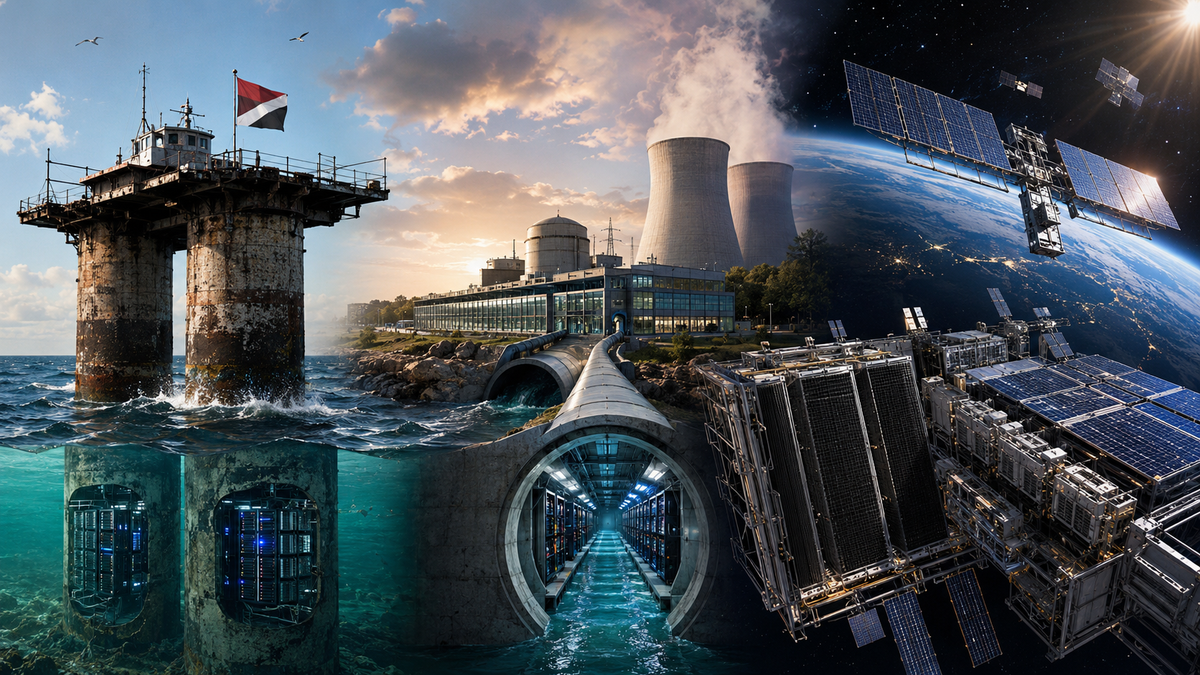
Welcome to Sealand. Now Bugger Off.
In 1942, the British Royal Navy drove two hollow concrete pylons into a sandbar called Rough Sands, 11 kilometers off the Suffolk coast, bolted a platform across the top, and stationed 150 sailors there to shoot at German aircraft. The war ended. The sailors went home. The platform stayed.
It was later discovered by a former British Army major who had been running pirate radio stations from platforms closer to shore. This one, however, happened to be just outside British territorial waters. It was claimed with a flag as the independent Principality of Sealand. AKA: Every kid’s dream clubhouse.
In 2000, a group of cypherpunks co-founded HavenCo with the Bates family and began moving servers onto Sealand. The pitch: store anything beyond any government’s reach. Think 2b2t, but with passports. Press coverage was enormous; Wired ran it on their cover. The client list was approximately twelve people.
The servers went inside the hollow concrete pylons, not on the platform, surrounded by the sub-surface North Sea. The accidental architecture is what makes Sealand interesting in hindsight, and what got me thinking, because those servers were passively ocean-cooled whether anyone planned it that way or not.
Between internet connections and other basic operations, Sealand was fraught with challenges that its autonomy complicated. It inevitably failed. But If seawater could passively (partially? potentially?) cool servers inside hollow concrete pylons in the North Sea, the obvious next question is what would happen if you took that idea seriously enough to take it to another level?
Davy Jones’ Data Centers
In June 2018, Microsoft lowered a pressurized cylinder onto the seafloor off Orkney, Scotland, at a depth of about 35 meters. Inside were 864 servers in a nitrogen atmosphere. When they retrieved it two years later, the server failure rate was one-eighth that of a comparable land-based facility. No oxidation, constant cold water, no humans bumping into things. The unexpected bonus: artificial reef.
Microsoft declared Project Natick inactive in 2024. The problem was not the failure rate, it’s that the vessel was sealed. While a fire-and-forget data center may be an SRE’s dream come true, GPU generations now turn over every 12 to 18 months, and a data center you cannot upgrade is a data center on a countdown. The AI hardware cycle moves faster than any permanently sealed enclosure can accommodate.
Underwater cooling works. Underwater maintenance does not. You cannot service hardware you cannot reach. If the hardware needs to stay accessible, it stays on land. The question then is how to get the ocean’s cooling capacity to a building that does not move.
Hand-Me-Down Cooling
Google’s data center in Hamina, Finland sits on the site of a former paper mill. Included with the property was a quarter-mile seawater tunnel, built decades earlier to cool pulp machinery. It was wide enough to drive a tractor through. Maintenance problem solved.
Google put titanium-plate heat exchangers at one end, filtration at the other, and has run Baltic seawater through the system since 2011. That tunnel has now cooled two completely different industries across several decades, both delivering some sort of news. Both being the media for sharing news was a coincidence, the need to remove heat from machines is not.
In 2024, Google and the local utility began building heat pumps to capture server waste heat and route it into the town’s district heating network. When complete, the system will provide up to 80 percent of Hamina’s total heat. The servers keep cool and the town stays warm. For real, that’s an elegant piece of engineering.
Facilities like this consume no freshwater. The ocean is an effectively infinite heat sink. Winning. Mostly. Minus the waste heat. That’s not going to be an issue, though, because the ocean does not generate electricity, and without power there’s nothing to cool. By the end of 2026, global data center electricity consumption is projected to exceed Japan’s entire annual usage. The grid cannot expand fast enough to meet that demand on current construction timelines.
3-Mile Copilot
Unit 2 at Three Mile Island is the one many may remember from 1979. Unit 1 is a different reactor that operated without incident until 2019, when it was shut down because natural gas prices had made it uneconomical. These two facts share only geography, but that geography carries a great deal of cultural weight.
A company called Constellation Energy is spending $1.6 billion to restart Unit 1, now called the Crane Clean Energy Center, with Microsoft as the buyer. Same Microsoft experimenting with underwater data centers. Same Microsoft making deals with AI software and hardware companies. Same Microsoft that brought you Clippy. And Copilot. And yes, it’s to power AI data centers.
With respect to clean power, solar is intermittent and nuclear runs almost continuously. Ask any submariner whose life depended on that under the polar ice for days or weeks at a time. Small enough to fit on a boat, nuclear for a data center would occupy blocks while the equivalent solar would need a small county worth of real estate. The move is both brilliant and terrifying.
In fact, every major hyperscaler has signed contracts for small modular reactors. Google with Kairos Power. Amazon with X-Energy. Meta with Oklo for something called the Prometheus AI supercluster. Unsure if that project manager was referencing the Titan or the Alien movie, but neither ended well for the humans. Regardless, all of them are just plans at this point.
The insights of those nuclear commitments tell a different story, though. The constraints are stacking, and they are all terrestrial. Limits on the grid, permit problems (forgiveness versus permission doesn’t work here), cooling needs, and real estate requirements. All of them, costs that just keep going up. And up. And...
Grok, in Spaaaaaaaaaace
In orbit, solar panels can run more efficiently and 24/7. So of course everyone has their sights set there.
Last year, a company called Starcloud trained a language model in orbit on the first Nvidia H100-class GPU ever flown in space. The model trained on Shakespeare and now responds in Elizabethan English. This is either charming or terrifying depending on your feelings about iambic pentameter.
SpaceX recently filed for a constellation of up to one million satellites for orbital compute in early 2026. It then absorbed xAI in a merger that conveniently valued the money-losing AI company at $250 billion just before SpaceX’s IPO. Google announced Project Suncatcher, a 2027 satellite AI demonstration mission. Starcloud filed for up to 88,000 satellites.
Those numbers deserve scrutiny, because the rocket that would make them possible does not exist yet. A fully reusable Falcon Heavy puts roughly 35 tons in low Earth orbit. Once you account for everything an orbital compute platform actually needs, the GPUs become almost insignificant volume and mass. Think about it: solar arrays, batteries, power conditioning, radiators, coolant loops, attitude control, communications, shielding, deployment hardware... (probably more, I’m not a rocket surgeon). The compute simply becomes the payload that everything else exists to support. At realistic mass budgets, a reusable Falcon Heavy launches something somewhere near 500 kilowatts of useful compute; a handful of data center racks per launch.
A million-satellite constellation is a bet on Starship, which promises 100 tons to LEO in reusable configuration. Launch 12 this week - don’t forget to watch! But seriously, that promise has to be fully realized before orbital compute scales beyond proof-of-concept, and Starship is not operational yet. Until it is, the constellation filings are ambition, not architecture.
A Swimming Pool of Radiator, Per Megawatt
Even with Starship firing on all 39, the physics of cooling in vacuum remain a challenge. Radiation is the only mechanism for heat dissipation in orbit, and radiation requires surface area. Dissipating one megawatt of waste heat requires roughly 1,200 square meters of radiating panel. Numbers like that are so mysterious. Think 30 meters by 40; a 100 foot square; an Olympic swimming pool.
Every megawatt of compute in orbit will need one of those connected to it. And another two swimming pools of solar panel to generate the electricity. Suddenly, the picture of what a “data center in space” actually looks like comes into focus: not the pizza boxes we’re used to seeing for Starlink, but like, entire city blocks making power and shedding heat, rivaling the International Space Station in size.
Disney predicted the cloud making it to space. Remember the dirty cloud of satellite debris surrounding Earth in WALL-E? Kessler Syndrome on the big screen. At constellation scale, that is thousands of city blocks in an orbital environment that already has a debris problem nobody has solved. Every panel needs precise orientation. Nothing can shade anything else. No astronauts are assembling this; every fluid coupling, every power connection, every deployment mechanism has to work autonomously in vacuum.
Kind of reminds me of this company that built a data center underwater.
What Comes Next
From sea to space, the pursuit of the optimal data center continues, and will likely do so for a very long time. Each breakthrough solves one problem at the expense of another. The Sealand story has always fascinated me, but IMO, Google’s got the crown right now with servers heating the town. I wonder if telling kids to go do their homework is like turning up the thermostat?