Enter With Caution
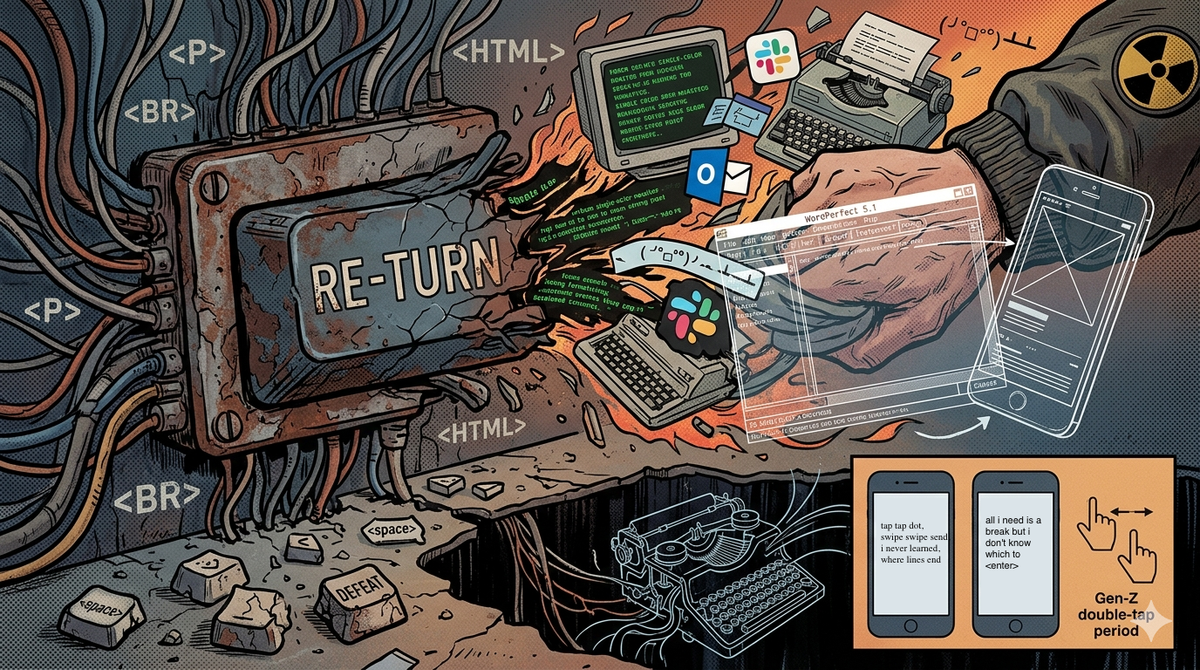
Ever stop to think about how many different ways you press the Enter key in a day? Maybe instead of Enter the one on your keyboard says Return, or maybe it has a broken arrow drawing on it. Not like Broken Arrow, the 90s blockbuster where John Travolta stole a nuke to... Oops. Maybe bent arrow would have been a better description. Anyway, that key. We'll call it <enter> for the duration of this conversation.
Most modern businesses use Slack, where <enter> might lead to accidentally sending a half-finished thought to your entire team before you were ready. Or think about pretty much any of the AI chatbots, where you want to split a thought into visual paragraphs so press <enter> to start a new line and instead you launch a half-baked prompt into the void.
Or flip the model. Not like a table (╯°□°)╯︵ ┻━┻ but think about it from the other direction. Think about how a web form used to submit when you pressed Enter and now just... doesn't.
The confusion, for me at least, began with word processors introducing the idea of formatted text. That would then continue into web browsers, which basically rule the internet now. How many of you know that many (if not most) apps you use today are extensions of the Chromium engine? Collections of “appy things” that are really just hiding a browser behind them.
The difference rapidly progressed from concepts like bolding text, which even DOS tools like WordPerfect could do way back pre-internet, to allowing for extra space before and/or after a paragraph. What visually appeared to be pressing <enter> twice was only once, so when you pasted it into another app you’d lose that visual break. Hardly tragic, but a bit of an interruption of flow. Perhaps it’s why we say “dam” when we do it.
Y’all know your personal mail is at Google and business mail is at Microsoft. Don’t lie. Ever forward a message between them? Outlook wraps your paragraphs in HTML tags that Gmail renders with extra spacing, so your carefully formatted email arrives looking double-spaced on the other end.
LinkedIn and Medium have both become biased, and I’m sure there are others. No matter what version you <enter>, adding shift or command or alt, how they choose to <return> it is highly opinionated. Medium flat-out blocks you from pressing <space> twice in a row. I get that browsers don’t care how many spaces are next to each other, they always display the same, but should they? Anyone have Berners-Lee’s number?
Pressbetween words. Press it twice between sentences. Or so I was taught. That particular debate has been raging since the introduction of more modern fonts. The division tends to be right around the era of those who grew up with typewriters and those that grew up with computers with monitors capable of more than one color.
I started off a double-spacer and regardless of decoration press <enter> twice, as well. Little by little I’m becoming a single-spacer. AUGH!!! I’ll tell you what, though... I still can’t find a pattern in the battle of <return>.
No, Gen-Y, variable-width fonts do not adjust their size based on whether they are between words or sentences. It is, however, why we have m-dashes and n-dashes. And the inclusion of the former gives away the fact that you didn’t do your homework (your AI is showing).
And for all you Gen-Z workers out there (if you can spare a moment) and your almost surgically-attached cell phones... go press <space> twice rapidly and tell me what you saw happen. Not why you think it happened. Not what you think should happen. Just what happened. <period>
All that talk about <enter>, <shift-enter>, variable-width, fixed-width, single-spacing, double-spacing, and thinking about how tokens work with LLMs got me thinking...
whenwillwestopcaringaboutformattingaltogetherandjustgetonwithit