My Entropy is Fighting Entropy
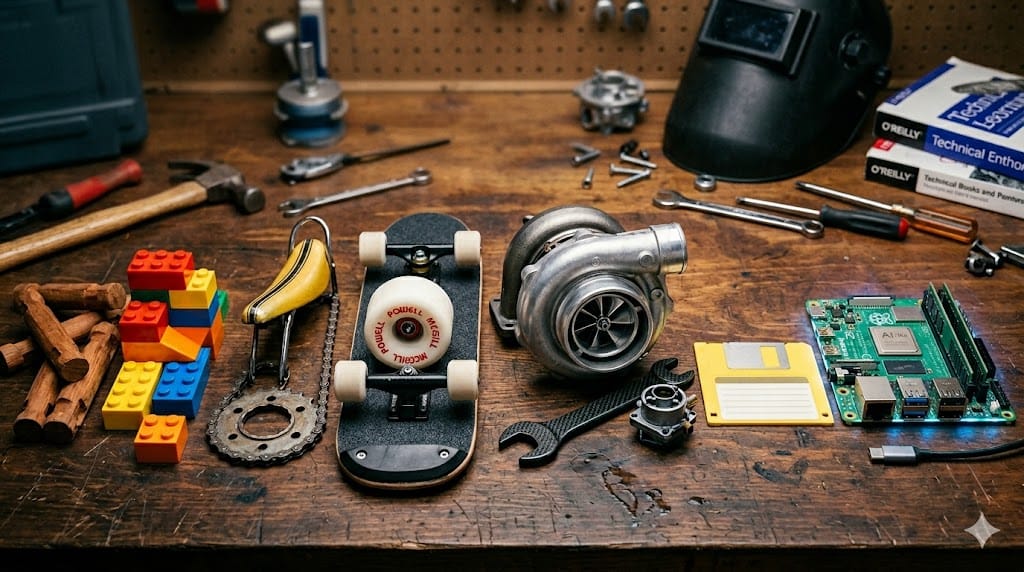
I like to simplify entropy as "the lowest energy state". The lowest energy state (highest entropy) in nature is not ordered, it's chaos. Or in simpler terms: broken. Leaking pipes, torn clothing, Xfinity offline.
Stacking rocks can be challenging; identifying the flattest surfaces and orienting for the correct balance. Hard work, organized result. Knocking that stack down could require a tiny push or a little time waiting, when entropy wins and the stack falls down on its own. Light work, chaotic result.
My lowest energy state is building. And fixing. Often, what I built.
Lincoln Logs and Lego
As far back as I can remember, I think Lincoln Logs were the first thing I really built with. Not sure those are even a thing anymore, so if you're unfamiliar, they were wooden sticks in different sizes with slots cut in them that you could stack in patterns. Like building a log cabin. You could make them square, rectangles, add bedrooms and living areas. Your only limit was your imagination. And how many your parents bought you.
I never got into placing furniture and stuff. Maybe I thought that was more "doll house", so I stuck to the framing and let my creativity flow. Looking back, placing that furniture would have been a bit more "completionist". These days, my OCD (not proper, more like overly-concerned-with-details) wouldn't let me sleep without finishing. Meh. I was five. I didn't care at the time.
Lego needs no introduction. Yes, I still build them, but giant stuff, like the ridiculously over-sized Millennium Falcon. The one thing I don't think I'll ever understand about modern large builds... why do they put orange and other colored pieces inside them that you don't see? I mean, it's not even aesthetic. Overstock?
On Two Wheels
What would turn out to be a life-long passion started early, as well. How many of you remember the first time you rode a bike? I do. Looking back to see my dad, just paces behind me, thinking he'd been holding on to the banana seat on my first bike while I pedaled down the sidewalk. That memory is locked in. And led to many stories in my life.
I'm sure my dad pushed me to do the simple things, like oiling the chain to prevent rust. I'm also sure I added too much and spun the wheel too fast more than once, spraying oil everywhere and probably laughing my ass off at the mess. I gradually learned it was easier to do this by flipping the bike onto its bars and seat, although the sissy bar made it more difficult.
The bell on the handlebars was the first to go. Next was that sissy bar, but it required changing the seat. So I changed the seat. It felt and looked like a dirt bike at that point. The gears in my head were turning. Next to go were the tires, replaced with legit off-road tires. I had to learn to tighten spokes to make the wheel true so the brakes worked properly. I started riding in the dirt and taking jumps. Handlebars had to go, the reach was wrong, they needed to be higher. Every change broke the balance and prompted another.
And so it would progress, gradually working my way up to mountain bikes, learning the difference in traction with different shape tires, living the evolution from rigid to suspended (my current ride is a full boing-boing), applauding the introduction of disk brakes, arguments over wheel sizes, the works. All the while I had to incorporate new understandings into decisions to continue the model I'd adopted too early; to "make it mine".
Ironically, after having switched to knobbies way back when on my Schwinn, I put street "slicks" on my mountain bike. Go figure.
Hooliganism
The best skateboard I ever owned I received for my 13th birthday. Not with a bow on it, but in separate packages I selected specifically to build it. Mike McGill deck, clear grip tape, nose guard, skid plate, rails, lapper, Indy trucks, Powell bearings and wheels. I had it assembled in an hour and rode that thing everywhere.
I'd later gut the trucks from it to build a Quicksilver deck with soft durometer wheels to blaze down nearby hills with reckless abandon. That would inevitably lead to a deep understanding of abrasion injuries.
The other parts made it onto a Christian Hosoi bonzai board that I snapped late one night on a half-pipe. Oops. No road rash, at least. I'd replace that with a symmetric deck with the entire underside a coating that removed the need for rails, hollow axles, high durometer wheels for sliding... it was a park board. And park I did, all day and all night until I screwed up a lip trick and did something to my knee it wasn't made to do.
Even the Andy Anderson board hanging in my garage is unique; contoured for flip tricks riding street but still capable of parks and pipes. Building skateboards isn't hard, but the range of boards and distinct characters in each speaks to understanding the sum of the parts. Even my first banana board, plastic and tiny, and cheap, had a purpose. To learn on. Like the banana seat on my first bike, it met as many needs as possible without specializing in any. Other than looking awful.
Just Add Oil
In high school, I rebuilt the carburetor of my first car in auto shop. I wasn't afraid because I'd taken so many other things apart, not only over the years, but on that specific car. That particular project earned me an 'A' the first month. I could cruise the rest of the semester, but I didn't.
Little by little I pushed further into teardowns and rebuilds to understand things. It started with small things like how to replace a seat rail bushing, to more complex problems like how the climate control works. I realized the more I was hands-on, the more I understood the principles that worked together as a system.
For example, exhaust leaving an engine moves through a manifold and into downpipes. There's an O2 sensor in there somewhere, then more pipes... you know what, it's a lot, and all serve a purpose. Each influences the others. Change one, or have something break, and you impact the others. Well, maybe not that chrome tip with Monza written on it.
Suspension is the same idea. It's not just shocks and springs; expand that to include body flex, alignment, here we go again... all to find a balance between comfort and capability, uniquely for each customer. More complicated than stacking rocks, but in the end it's no different. There's an optimal state, difficult to achieve, and the tiniest change can upset everything.
One of my first jobs, and probably still my favorite, was a humble repair shop on the surface, but for "those who knew" we were a performance shop. We did heavy customizations, including turbo systems, stancing, bodywork, interiors, even high-end audio and alarms (they were all the rage back then). Twice, a car I worked on was at the SEMA show in Las Vegas.
Ever have one of those "how did I get here" moments? At that car shop, I migrated the process for shipping mail order parts from paper to a computer. I'd been asked to transition from changing oil to building race cars and show cars. No one asked me to build software, but I could, and I did.
Ones and Zeroes. Simpler, Right?
I was already familiar with computers. My first was bought by my uncle. It had two 5-1/4" floppy drives, a yellow monochrome monitor, and was upgraded to a full 1MB RAM. I'm writing this on an M5 Mac with 32GB. Lotus 1-2-3, anyone? So I was writing custom code and formulas into the program and it reached a point where the people in tech support couldn't answer my questions and suggested I should just work there myself. So I did.
My first day on the new job I introduced myself to a stranger on the elevator. "Hi, I'm Steve Cole, I work in Tech Support". I reached out to shake his hand. His response: "Hi, I'm Gordon Eubanks, I'm the CEO". Oh god.
I would move to Oregon with that job, stay a year, help a friend build a REAL log cabin, find another job in Cupertino (one of the old Apple buildings), move back, and start learning Windows and networking. Really learning them. This is pre-WinSock, back when IPX/SPX and dial-up were the norm. I started supporting the SDK product that developers use to build their own products. I was back in my lane, more building than fixing. My itch was being scratched again.
A couple years later, I'd land a job running the technical side of a startup, IT and Engineering in one. I'd eventually lead a team to write a CGI-based Perl application back before SaaS was a thing. I think Amazon only sold books at the time, and buy them I did. O'Reilly was my new thing; I ate them up and learned everything I could about Linux and programming. I was buying books on vi, sed, awk, SQL... all tools in the new toolbox I was assembling.
After building a home banking system for a small credit union (don't ask me for stories about that, just be thankful NCUA exists) a friend got me an interview at Adobe. My first day there I found two Juniper firewalls and two F5 load balancers on my desk with the mission to configure them, fly to LA, and install them. Yahtzee!
I'd "commute" to LA for about a year, building out the data center that would inevitably serve the transition from Adobe as a product company to a service company. Then we did it again in Miami, despite the late nights and early mornings trying to optimize configurations or fix problems. I even earned a private cloud infrastructure patent doing that work. That's some serious nerd cred, but if I'm honest, SEMA earns me more high fives.
The data center house of cards collapsed and Adobe moved to the cloud when AWS added compute on top of storage. After decoding their ever-growing pile of offerings and untangling those bills for a few years, I too would move to AWS. The breadth of exposure to massive companies was extraordinary. The opportunities to connect with people and share the "how to" of the cloud were invigorating. I was the O'Reilly book at that point. What was I building within them, and what would they build with that?
Breathe
Since I started freelancing, most of my building is personal projects. Be it web apps, teaching a car to drive using evolutionary ML, stock trading, microservices, containers, or orchestrated AI, I can't peel myself away from building. And fixing. I mentioned fixing, right? The two go hand-in-hand, there's no escaping it. No matter how well you think you build something, it will always find a way to fall down. Honestly, fixing requires troubleshooting, and that earns its own respect, just as building does.
Oh geez, I didn't mention anything about all the stuff with my house. Leaking pipes, torn clothing, Xfinity offline. My entropy is fighting that, too.